More Notation and Terminology
 Complex Basics
 Complex Numbers
Contents
Global Contents
Complex Numbers
Contents
Global Contents
 Global Index
Index
Search
Global Index
Index
Search
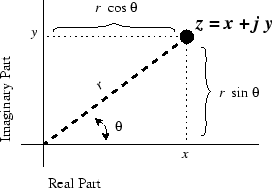
We can plot any complex number  in a plane as an ordered pair
 , as shown in Fig. 2.2. A complex plane (or
Argand diagram) is any 2D graph in which the horizontal axis is
the real part and the vertical axis is the imaginary
part of a complex number or function. As an example, the number
, as shown in Fig. 2.2. A complex plane (or
Argand diagram) is any 2D graph in which the horizontal axis is
the real part and the vertical axis is the imaginary
part of a complex number or function. As an example, the number  has coordinates
  in the complex plane while the number
  has
coordinates
has
coordinates  .
.
Plotting as the point in the complex plane can be
viewed as a plot in Cartesian or
rectilinear coordinates. We can
also express complex numbers in terms of polar coordinates as
an ordered pair
 , where
  is the distance from the
origin
is the distance from the
origin  to the number being plotted, and
  is the angle
of the number relative to the positive real coordinate axis (the line
defined by
is the angle
of the number relative to the positive real coordinate axis (the line
defined by  and
and  ). (See Fig. 2.2.)
Using elementary geometry, it is quick to show that conversion from rectangular to polar coordinates is accomplished by the formulas

 denotes the arctangent of
  (the angle
in radians whose tangent is
(the angle
in radians whose tangent is
 ). We will
take in the range
). We will
take in the range  to
to  (although we could choose
any interval of length
(although we could choose
any interval of length  radians, such as 0 to , etc.).
The first equation (for ) follows immediately from the
Pythagorean theorem, while the second follows
immediately from the definition of the tangent function.
radians, such as 0 to , etc.).
The first equation (for ) follows immediately from the
Pythagorean theorem, while the second follows
immediately from the definition of the tangent function.
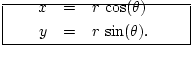
Similarly, conversion from polar to rectangular coordinates is simply
More Notation and Terminology
Complex Basics
Complex Numbers
Contents
Global Contents
Global Index
Index
Search
 (automatic links disclaimer)