 Complex Roots
 Factoring a Polynomial
 Complex Numbers
Contents
Global Contents
Complex Numbers
Contents
Global Contents
 Global Index
Index
Search
Global Index
Index
Search
The general second-order (real) polynomial is
 are any real numbers, and we assume
  since otherwise
it would not be second order. Some experiments plotting
since otherwise
it would not be second order. Some experiments plotting  for different
values of the coefficients leads one to guess that the curve is always a
scaled and translated parabola. The canonical parabola centered
at
for different
values of the coefficients leads one to guess that the curve is always a
scaled and translated parabola. The canonical parabola centered
at  is given by
 determines the width (and up or down direction) and
  provides an arbitrary vertical offset. If we can find
  in
terms of for any quadratic polynomial, then we can easily
factor the polynomial. This is called ``completing the square.''
Multiplying out the right-hand side of Eq. (2.2) above, we get
in
terms of for any quadratic polynomial, then we can easily
factor the polynomial. This is called ``completing the square.''
Multiplying out the right-hand side of Eq. (2.2) above, we get
 to the general second-order
polynomial in Eq. (2.1) gives
to the general second-order
polynomial in Eq. (2.1) gives

Using these answers, any second-order polynomial
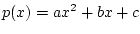 can be rewritten as a scaled, translated parabola

 to get

 is negative? This introduces the
square root of a negative number which we could insist ``does not exist.''
Alternatively, we could invent complex numbers to accommodate it.
is negative? This introduces the
square root of a negative number which we could insist ``does not exist.''
Alternatively, we could invent complex numbers to accommodate it.
Complex Roots
Factoring a Polynomial
Complex Numbers
Contents
Global Contents
Global Index
Index
Search
 (automatic links disclaimer)


