 Back to Mth Roots
 Back to e
 Proof of Euler's Identity
Contents
Global Contents
Proof of Euler's Identity
Contents
Global Contents
 Global Index
Index
Search
Global Index
Index
Search
We've now defined  for any positive real number
  and any
complex number
and any
complex number  . Setting
  and
and  gives us the
special case we need for Euler's identity. Since
gives us the
special case we need for Euler's identity. Since  is its own
derivative, the Taylor series expansion for
is its own
derivative, the Taylor series expansion for  is one of
the simplest imaginable infinite series:
is one of
the simplest imaginable infinite series:

 for all
  and because
we chose to expand about the point
and because
we chose to expand about the point  . We of course define

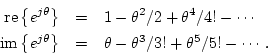
Comparing the Maclaurin expansion for
 with that of
 and
and
 proves Euler's identity. Recall
from introductory calculus that
proves Euler's identity. Recall
from introductory calculus that
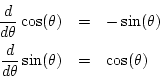
so that
![\begin{eqnarray*}
\left.\frac{d^n}{d\theta^n}\cos(\theta)\right\vert _{\theta=0}...
...} \\ [5pt]
0, & n\;\mbox{\small even}. \\
\end{array} \right.
\end{eqnarray*}](img286.png)
Plugging into the general Maclaurin series gives
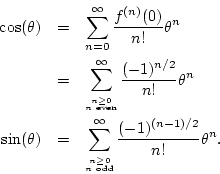
Separating the Maclaurin expansion for
into its even and odd
terms (real and imaginary parts) gives

thus proving Euler's identity.
Back to Mth Roots
Back to e
Proof of Euler's Identity
Contents
Global Contents
Global Index
Index
Search
 (automatic links disclaimer)