


Assume a 3D surface point  that is projected onto its corresponding
image points
that is projected onto its corresponding
image points
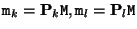 . The inverse process
holds for triangulating from the corresponding point pair
. The inverse process
holds for triangulating from the corresponding point pair
 . We can in fact exploit the calibrated camera geometry
and express the 3D point as a depth value
. We can in fact exploit the calibrated camera geometry
and express the 3D point as a depth value  along the known line
of sight
along the known line
of sight
 that extends from the camera projection center through
the image correspondence
that extends from the camera projection center through
the image correspondence  . Triangulation computes the depth as the
length of
connecting the camera projection center and the locus
of minimum distance between the corresponding lines of sight. The
triangulation is computed for each image point and stored in a dense depth map
associated with the viewpoint.
. Triangulation computes the depth as the
length of
connecting the camera projection center and the locus
of minimum distance between the corresponding lines of sight. The
triangulation is computed for each image point and stored in a dense depth map
associated with the viewpoint.
The depth for each reference image point  is improved by the correspondence
linking that delivers two lists of image correspondences relative to
the reference, one linking down from
is improved by the correspondence
linking that delivers two lists of image correspondences relative to
the reference, one linking down from
 and one linking up from
 . For each valid corresponding point
pair
. For each valid corresponding point
pair
 we can triangulate a consistent depth estimate
 along
with
along
with  representing the
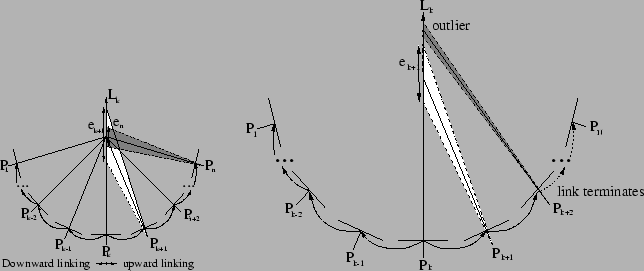
depth uncertainty. Figure 7.17(left)
visualizes the decreasing uncertainty interval during linking. While the disparity
measurement resolution
representing the
depth uncertainty. Figure 7.17(left)
visualizes the decreasing uncertainty interval during linking. While the disparity
measurement resolution  in the image is kept constant (at 1 pixel), the reprojected
depth error decreases with the baseline.
in the image is kept constant (at 1 pixel), the reprojected
depth error decreases with the baseline.
 |