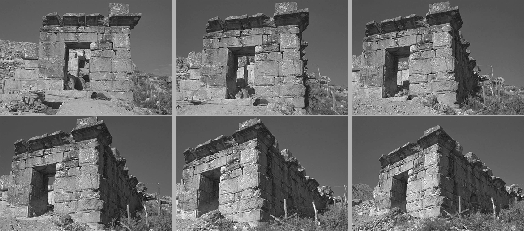
The 3D surface acquisition technique that we have developed can be applied readily to archaeological sites. The on-site acquisition procedure consists of recording an image sequence of the scene that one desires to virtualize. To allow for the algorithms to yield good results viewpoint changes between consecutive images should not exceed 5 to 10 degrees. An example of such a sequence is given in Figure 9.13.
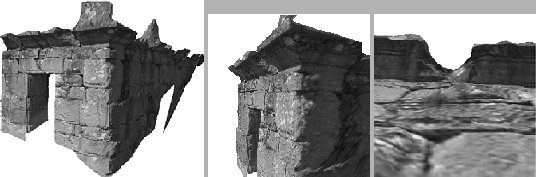
The result for the image sequence under consideration can be seen in Figure 9.14. An important advantage is that details like missing stones, not perfectly planar walls or symmetric structures are preserved. In addition the surface texture is directly extracted from the images. This does not only result in a much higher degree of realism, but is also important for the authenticity of the reconstruction. Therefore the reconstructions obtained with this system could also be used as a scale model on which measurements can be carried out or as a tool for planning restorations.As a second example, the reconstruction of the remains of an ancient fountain is shown. In Figure 9.15 three of the six images used for the reconstruction are shown. All images were taken from the same ground level. They were acquired with a digital camera with a resolution of approximately 1500x1000. Half resolution images were used for the computation of the shape. The texture was generated from the full resolution images.
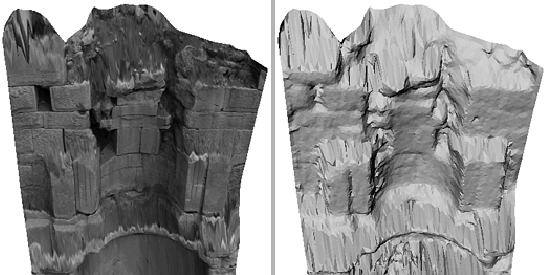
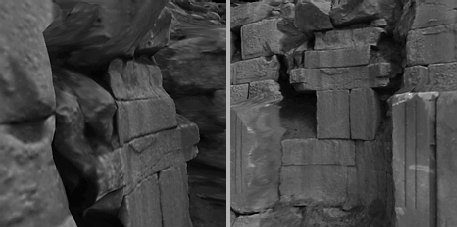
The reconstruction can be seen in Figure 9.16, the left side shows a view with texture, the right view gives a shaded view of the model without texture. In Figure 9.17 two close-up shots of the model are shown.