 Imaginary Exponents
 Real Exponents
 Proof of Euler's Identity
Contents
Global Contents
Proof of Euler's Identity
Contents
Global Contents
 Global Index
Index
Search
Global Index
Index
Search
Most ``smooth'' functions  can be expanded in the form of a
Taylor series expansion:
can be expanded in the form of a
Taylor series expansion:


 is pronounced ``
 factorial''.
An informal derivation of this formula for
factorial''.
An informal derivation of this formula for  is given in
Appendix A. Clearly, since many
derivatives are involved, a Taylor series expansion is only possible
when the function is so smooth that it can be differentiated again and
again. Fortunately for us, all audio signals are in that category,
because hearing is bandlimited to
is given in
Appendix A. Clearly, since many
derivatives are involved, a Taylor series expansion is only possible
when the function is so smooth that it can be differentiated again and
again. Fortunately for us, all audio signals are in that category,
because hearing is bandlimited to  kHz, and the audible
spectrum of any sum of sinusoids is infinitely differentiable. (Recall
that
kHz, and the audible
spectrum of any sum of sinusoids is infinitely differentiable. (Recall
that
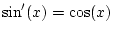 and
and
 ,
etc.). See §A.6 for more about this point.
,
etc.). See §A.6 for more about this point.
Imaginary Exponents
Real Exponents
Proof of Euler's Identity
Contents
Global Contents
Global Index
Index
Search
 (automatic links disclaimer)