 A First Look at Taylor Series
 Rational Exponents
 Proof of Euler's Identity
Contents
Global Contents
Proof of Euler's Identity
Contents
Global Contents
 Global Index
Index
Search
Global Index
Index
Search
The closest we can actually get to most real numbers is to compute a
rational number that is as close as we need. It can be shown that
rational numbers are dense in the real numbers; that is,
between every two real numbers there is a rational number, and between
every two rational numbers is a real number. An
irrational number can be defined as any real
number having a non-repeating decimal expansion. For example,
 is an irrational real number whose decimal expansion starts
out as3.1
is an irrational real number whose decimal expansion starts
out as3.1


 to denote the repeating part of a
decimal expansion, a repeating example is as follows:
to denote the repeating part of a
decimal expansion, a repeating example is as follows:
![\begin{eqnarray*}
x &=& 0.\overline{123} \\ [5pt]
\quad\Rightarrow\quad 1000x &=...
...999x &=& 123\\ [5pt]
\quad\Rightarrow\quad x &=& \frac{123}{999}
\end{eqnarray*}](img227.png)
Other examples of irrational numbers include

Their decimal expansions do not repeat.
Let
 denote the
  -digit decimal expansion of an arbitrary real
number
-digit decimal expansion of an arbitrary real
number  . Then
is a rational number (some integer over
. Then
is a rational number (some integer over  ).
We can say
).
We can say
 as goes to infinity is .
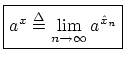
Since
 is defined for all , we naturally define
  as the following mathematical limit:
A First Look at Taylor Series
Rational Exponents
Proof of Euler's Identity
Contents
Global Contents
Global Index
Index
Search
 (automatic links disclaimer)