


For dense correspondence matching a disparity estimator based on
the dynamic programming scheme of Cox et al. [26], is employed
that incorporates the above mentioned constraints.
It operates on rectified image pairs where the
epipolar lines coincide with image scan lines. The matcher searches at
each pixel in image  for maximum normalized cross correlation in
  by shifting a small measurement window (kernel size 5x5 or 7x7) along the
corresponding scan line. The selected search step size
by shifting a small measurement window (kernel size 5x5 or 7x7) along the
corresponding scan line. The selected search step size
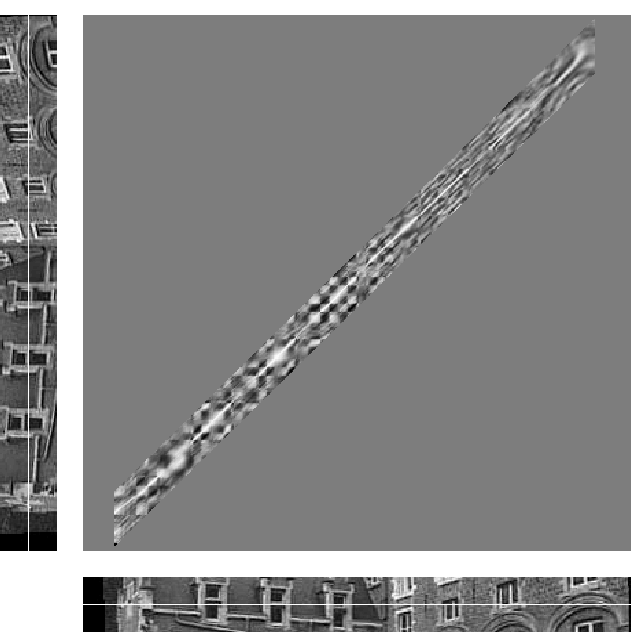
 (usually 1 pixel) determines the search resolution and the minimum and maximum disparity values determine the search region. This is illustrated in Figure 7.3.
 |
Matching ambiguities are
resolved by exploiting the ordering constraint in the dynamic
programming approach [86]. The algorithm was further
adapted to employ extended neighborhood relationships and a pyramidal
estimation scheme to reliably deal with very large disparity ranges of
over 50% of the image size [39]. The estimate is stored in
a disparity map  with one of the following values:
- a valid correspondence
![${\tt m}^k_l = D_{(k,l)}[{\tt m}^l_k]$](img714.gif) ,
,
- an undetected search failure which leads to an outlier,
- a detected search failure with no correspondence.
A confidence value is kept together with the correspondence that tells if a
correspondence is valid and how good it is. The confidence is derived from the local image variance and the maximum cross correlation[90].
To further reduce measurement outliers the uniqueness constraint is employed
by estimating correspondences bidirectionally
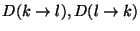 .
Only the consistent correspondences with
.
Only the consistent correspondences with
 are kept as valid correspondences.