


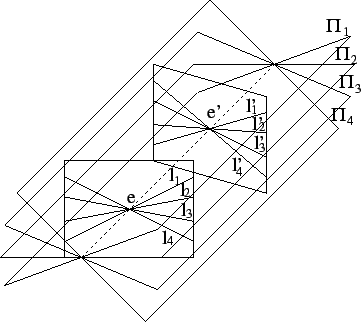
The epipolar lines can be oriented such that the matching ambiguity is reduced to half epipolar lines instead of full epipolar lines. This is important when the epipole is in the image. This fact was ignored in the approach of Roy et al. [163].
Figure 7.5 illustrates this concept. Points located in the right halves of the epipolar planes will be projected on the right part of the image planes and depending on the orientation of the image in this plane this will correspond to the right or to the left part of the epipolar lines. These concepts are explained more in detail in the work of Laveau [95] on oriented projective geometry (see also [61]).
 |
In practice this orientation can be obtained as follows. Besides the epipolar geometry one point match is needed (note that 7 or more matches were needed anyway to determine the epipolar geometry). An oriented epipolar line  separates the image plane into a positive and a negative region:
![\begin{displaymath}
f_{\tt l}({\tt m})={\tt l}^\top{\tt m} \mbox{ with } {\tt m}=[x \, y \, 1]^\top
\end{displaymath}](img729.gif) |
(G5) |
is restricted to a strictly positive scale factor. For a pair of matching points  both
both
 and
and
 should have the same sign . Since
  is obtained from through equation (7.2), this allows to determine the sign of
  . Once this sign has been determined the epipolar line transfer is oriented. We take the convention that the positive side of the epipolar line has the positive region of the image to its right. This is clarified in Figure 7.6.
