


 as the number of views linked to the reference
view. Another important feature of the algorithm is the density and
accuracy of the depth maps. To describe its improvement over the 2-view
estimator, we define the fill rate
as the number of views linked to the reference
view. Another important feature of the algorithm is the density and
accuracy of the depth maps. To describe its improvement over the 2-view
estimator, we define the fill rate  and
the average relative depth error
and
the average relative depth error  as additional measures.
Visibility ![$V[views]$](img792.gif) : : |
average number of views linked to the reference image. |
Fill Rate ![$F[\%]$](img793.gif) : : |
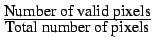 |
Depth error ![$E[\%]$](img795.gif) : : |
standard deviation of relative depth error  for all valid pixels. for all valid pixels. |
The 2-view disparity estimator is a special case of the proposed
linking algorithm, hence both can be compared on an equal basis. The
2-view estimator operates on the image pair  only, while the
multi-view estimator operates on a sequence
only, while the
multi-view estimator operates on a sequence  with
with  .
The above defined statistical measures were computed for different
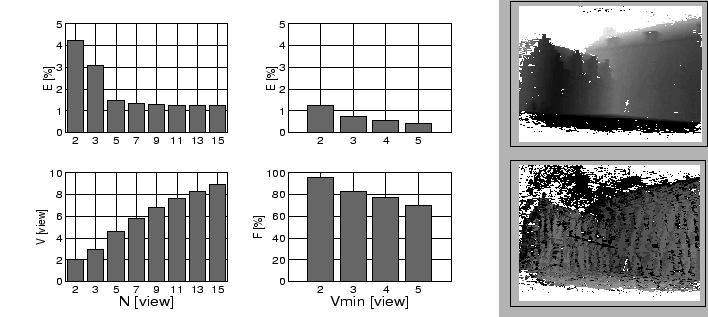
sequence lengths N. Figure 7.18 displays visibility and
relative depth error for sequences from 2 to 15 images, chosen
symmetrically around the reference image. The average visibility
shows that for up to 5 images nearly all views are utilized. For 15
images, at average 9 images are linked. The amount of linking is reflected in
the relative depth error that drops from 5% in the 2 view estimator
to about 1.2% for 15 images.
.
The above defined statistical measures were computed for different
sequence lengths N. Figure 7.18 displays visibility and
relative depth error for sequences from 2 to 15 images, chosen
symmetrically around the reference image. The average visibility
shows that for up to 5 images nearly all views are utilized. For 15
images, at average 9 images are linked. The amount of linking is reflected in
the relative depth error that drops from 5% in the 2 view estimator
to about 1.2% for 15 images.
 |
Linking two views is the minimum case that allows triangulation. To
increase the reliability of the estimates, a surface point should
occur in more than two images. We can therefore impose a minimum visibility
 on a depth estimate. This will reject unreliable depth estimates
effectively, but will also reduce the fill rate of the depth map.
on a depth estimate. This will reject unreliable depth estimates
effectively, but will also reduce the fill rate of the depth map.
The graphs in figure 7.18(center) show the dependency of the fill rate and depth error on minimum visibility for N=11. The fill rate drops from 92% to about 70%, but at the same time the depth error is reduced to 0.5% due to outlier rejection. The depth map and the relative error distribution over the depth map is displayed in Figure 7.18(right). The error distribution shows a periodic structure that in fact reflects the quantization uncertainty of the disparity resolution when it switches from one disparity value to the next.
 on visibility
  (center). Depth map (above: dark=near, light=far) and error map (below: dark=large error, light=small error) for
  (right).