


![${\tt\Pi}_\infty = [0 \,0 \,0 \,1]^\top$](img237.gif) ). This is easy to achieve when starting from a Euclidean representation. Starting from a projective representation, however, the structure is only determined up to an arbitrary projective transformation. As was seen, these transformations do - in general - not leave the plane at infinity unchanged.
). This is easy to achieve when starting from a Euclidean representation. Starting from a projective representation, however, the structure is only determined up to an arbitrary projective transformation. As was seen, these transformations do - in general - not leave the plane at infinity unchanged.
Therefore, in a specific projective representation, the plane at infinity can be anywhere. In this case upgrading the geometric structure from projective to affine implies that one first has to find the position of the plane at infinity in the particular projective representation under consideration.
This can be done when some affine properties of the scene are known. Since parallel lines or planes are intersecting in the plane at infinity, this gives constraints on the position of this plane. In Figure 2.1 a projective representation of a cube is given. Knowing this is a cube, three vanishing points can be identified. The plane at infinity is the plane containing these 3 vanishing points.
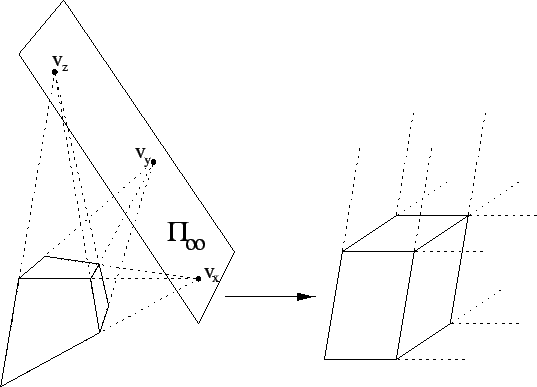 |
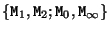
Ratios of lengths along a line define the point at infinity of that line. In this case the points  ,
,  ,
,  and the cross-ratio
 are known, therefore the point
 can be computed.
Once the plane at infinity
 is known, one can upgrade the projective representation to an affine one by applying a transformation which brings the plane at infinity to its canonical position. Based on (2.9) this equation should therefore satisfy
![\begin{displaymath}
\left[ \begin{array}{c} 0 \\ 0 \\ 0 \\ 1 \end{array} \right]...
...}{c} 0 \\ 0 \\ 0 \\ 1 \end{array} \right] \sim {\tt\Pi}_\infty
\end{displaymath}](img252.gif) |
(B24) |
 . Since, at this level, the other elements are not constrained, the obvious choice for the transformation is the following
 the first 3 elements of
when the last element is scaled to 1.
It is important to note, however, that every transformation of the form
to
the first 3 elements of
when the last element is scaled to 1.
It is important to note, however, that every transformation of the form
to
![$[0 \, 0\, 0\, 1]^\top$](img256.gif) .
.
![\begin{displaymath}
{\bf T}_{PA} \sim \left[\begin{array}{cc} {\bf I}_{3 \times 3} & 0_3 \\
{\tt\pi}_\infty^\top & 1\end{array} \right]
\end{displaymath}](img253.gif)
![\begin{displaymath}
\left[\begin{array}{cc} {\bf A} & 0_3 \\
{\tt\pi}_\infty^\top & 1\end{array} \right] \mbox{ with } \det {\bf A} \neq 0
\end{displaymath}](img255.gif)