With an actual camera the focal length  (i.e. the distance between the center of projection and the retinal plane) will be different from 1, the coordinates of equation (3.2) should therefore be scaled with to take this into account.
In addition the coordinates in the image do not correspond to the physical coordinates in the retinal plane. With a CCD camera the relation between both depends on the size and shape of the pixels and of the position of the CCD chip in the camera. With a standard photo camera it depends on the scanning process through which the images are digitized.
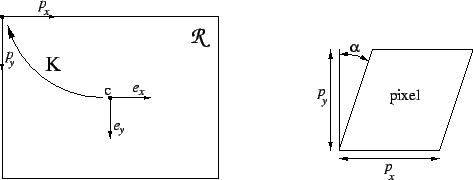
The transformation is illustrated in Figure 3.3. The image coordinates are obtained through the following equations:
![\begin{displaymath}
\left[\begin{array}{c} x \\ y \\ 1 \end{array}\right] =
\lef...
...in{array}{c} x_{\cal R} \\ y_{\cal R} \\ 1 \end{array}\right]
\end{displaymath}](img308.gif)
 and
and  are the width and the height of the pixels,
![${\tt c}=[c_x \, c_y \, 1]^\top$](img311.gif) is the principal point and
is the principal point and  the skew angle as indicated in Figure 3.3. Since only the ratios
  and
and  are of importance the simplified notations of the following equation will be used in the remainder of this text:
 and
and  being the focal length measured in width and height of the pixels, and
  a factor accounting for the skew due to non-rectangular pixels. The above upper triangular matrix is called the calibration matrix of the camera; and the notation
  will be used for it. So, the following equation describes the transformation from retinal coordinates to image coordinates.
is very close to zero. Furthermore, the principal point is often close to the center of the image. These assumptions can often be used, certainly to get a suitable initialization for more complex iterative estimation procedures.
will be used for it. So, the following equation describes the transformation from retinal coordinates to image coordinates.
is very close to zero. Furthermore, the principal point is often close to the center of the image. These assumptions can often be used, certainly to get a suitable initialization for more complex iterative estimation procedures.
For a camera with fixed optics these parameters are identical for all the images taken with the camera. For cameras which have zooming and focusing capabilities the focal length can obviously change, but also the principal point can vary. An extensive discussion of this subject can for example be found in the work of Willson [219,217,218,220].
![\begin{displaymath}
\left[\begin{array}{c} x \\ y \\ 1 \end{array}\right] =
\lef...
...gin{array}{c} x_{\cal R} \\ y_{\cal R} \\ 1 \end{array}\right]
\end{displaymath}](img315.gif)