 Exponentials
 Sinusoids at the Same Frequency
 Sinusoids
Contents
Global Contents
Sinusoids
Contents
Global Contents
 Global Index
Index
Search
Global Index
Index
Search
Sinusoidal signals are analogous to monochromatic laser light. You
might have seen ``speckle'' associated with laser light, caused by
destructive interference of multiple reflections of the light beam. In
a room, the same thing happens with sinusoidal sound. For example,
play a simple sinusoidal tone (e.g., ``A-440''--a sinusoid at
frequency  Hz) and walk around the room with one ear
plugged. If the room is reverberant you should be able find places
where the sound goes completely away due to destructive interference.
In between such places (which we call ``nodes'' in the soundfield),
there are ``antinodes'' at which the sound is louder by 6
dB4.2 (amplitude
doubled) due to constructive interference. In a diffuse reverberant
soundfield, the distance between nodes is on the order of a wavelength
(the ``correlation distance'' within the random soundfield).
Hz) and walk around the room with one ear
plugged. If the room is reverberant you should be able find places
where the sound goes completely away due to destructive interference.
In between such places (which we call ``nodes'' in the soundfield),
there are ``antinodes'' at which the sound is louder by 6
dB4.2 (amplitude
doubled) due to constructive interference. In a diffuse reverberant
soundfield, the distance between nodes is on the order of a wavelength
(the ``correlation distance'' within the random soundfield).
The way reverberation produces nodes and antinodes for sinusoids in a
room is illustrated by the simple comb filter, depicted in
Fig. 4.3.4.3
Figure 4.3 also plots a portion of the unit-amplitude, sinusoidal
input signal. Since the comb filter is linear and time-invariant, its
response to a sinusoid must be sinusoidal (see previous section). The
output signal is plotted for two different choices of delay. The
feedforward path has gain  , and the delay is one period in the
first case and half a period in the second. With the delay set to one
period, the unit amplitude sinusoid coming out of the delay line
constructively interferes with the amplitude sinusoid
from the feed-forward path, and the output amplitude is therefore
, and the delay is one period in the
first case and half a period in the second. With the delay set to one
period, the unit amplitude sinusoid coming out of the delay line
constructively interferes with the amplitude sinusoid
from the feed-forward path, and the output amplitude is therefore
 . In the other case, with the delay set to
half a period, the unit amplitude sinusoid coming out of the
delay line destructively interferes with the amplitude
sinusoid from the feed-forward path, and the output amplitude
therefore drops to
. In the other case, with the delay set to
half a period, the unit amplitude sinusoid coming out of the
delay line destructively interferes with the amplitude
sinusoid from the feed-forward path, and the output amplitude
therefore drops to
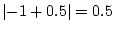 .
.
Consider a fixed delay of  seconds for the delay line in
Fig. 4.3. Constructive interference happens at all
frequencies for which an exact integer number of periods fits
in the delay line, i.e.,
seconds for the delay line in
Fig. 4.3. Constructive interference happens at all
frequencies for which an exact integer number of periods fits
in the delay line, i.e.,
 , or
, or  , for
, for
 . On the other hand, destructive interference
happens at all frequencies for which number of periods in the delay
line is an integer plus a half, i.e.,
. On the other hand, destructive interference
happens at all frequencies for which number of periods in the delay
line is an integer plus a half, i.e.,
 etc.,
or,
etc.,
or,
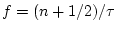 , for
. It is quick to
verify that frequencies of constructive interference alternate with
frequencies of destructive interference, and therefore the
amplitude response of the comb filter (a plot of gain versus
frequency) looks as shown in Fig. 4.4.
, for
. It is quick to
verify that frequencies of constructive interference alternate with
frequencies of destructive interference, and therefore the
amplitude response of the comb filter (a plot of gain versus
frequency) looks as shown in Fig. 4.4.
The amplitude response of a comb filter has a ``comb'' like shape,
hence the name.4.4 Note that
if the feedforward gain is increased from to  , the
comb-filter gain ranges between 0 (complete cancellation) and
, the
comb-filter gain ranges between 0 (complete cancellation) and  .
Negating the feedforward gain inverts the gain curve, placing a
minimum at dc4.5 instead of a peak.
.
Negating the feedforward gain inverts the gain curve, placing a
minimum at dc4.5 instead of a peak.
Exponentials
Sinusoids at the Same Frequency
Sinusoids
Contents
Global Contents
Global Index
Index
Search
 (automatic links disclaimer)

 sec.
sec.