In this section the following question will be addressed: Given an image point in one image, does this restrict the position of the corresponding image point in another image? It turns out that it does and that this relationship can be obtained from the calibration or even from a set of prior point correspondences.
Although the exact position of the scene point  is not known, it is bound to be on the line of sight of the corresponding image point
  . This line can be projected in another image and the corresponding point
  is bound to be on this projected line
  . This is illustrated in Figure 3.5.
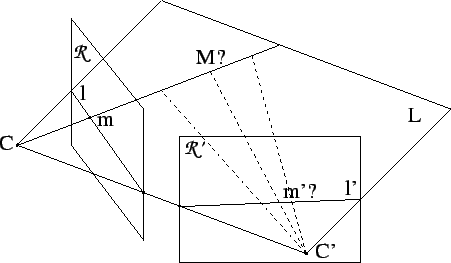 |
 defined by the two projection centers and have their image on . Similarly, all these points are projected on a line
  in the first image.
and are said to be in epipolar correspondence (i.e. the corresponding point of every point on is located on , and vice versa).
in the first image.
and are said to be in epipolar correspondence (i.e. the corresponding point of every point on is located on , and vice versa).
Every plane passing through both centers of projection  and
and  results in such a set of corresponding epipolar lines, as can be seen in Figure 3.6. All these lines pass through two specific points
  and
and  . These points are called the epipoles, and they are the projection of the center of projection in the opposite image.
 |
This epipolar geometry can also be expressed mathematically. The fact that a point is on a line can be expressed as
 . The line passing trough and the epipole is
![$[{\tt e}]_\times$](img402.gif) the antisymmetric
the antisymmetric  matrix representing the vectorial product with .
From (3.9) the plane corresponding to is easily obtained as
 and similarly
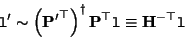
 . Combining these equations gives:
 indicating the Moore-Penrose pseudo-inverse. The notation
 is inspired by equation (2.7). Substituting (3.23) in (3.24) results in
![\begin{displaymath}
{\tt l}' \sim {\bf H}^{-\top} [{\tt e}]_\times {\tt m} \enspace .
\end{displaymath}](img408.gif)
![${\bf F} = {\bf H}^{-\top} [{\tt e}]_\times$](img409.gif) , we obtain
, we obtain
 is called the fundamental matrix. These concepts were introduced by Faugeras [44] and Hartley [60]. Since then many people have studied the properties of this matrix (e.g. [102,103]) and a lot of effort has been put in robustly obtaining this matrix from a pair of uncalibrated images [195,196,225].
Having the calibration, can be computed and a constraint is obtained for corresponding points. When the calibration is not known equation (3.26) can be used to compute the fundamental matrix . Every pair of corresponding points gives one constraint on . Since is a matrix which is only determined up to scale, it has
 unknowns. Therefore 8 pairs of corresponding points are sufficient to compute with a linear algorithm.
Note from (3.25) that
 , because
![$[{\tt e}]_\times {\tt e} = 0$](img414.gif) . Thus,
. Thus,
 . This is an additional constraint on and therefore 7 point correspondences are sufficient to compute through a nonlinear algorithm.
In Section 4.3 the robust computation of the fundamental matrix from images will be discussed in more detail.
. This is an additional constraint on and therefore 7 point correspondences are sufficient to compute through a nonlinear algorithm.
In Section 4.3 the robust computation of the fundamental matrix from images will be discussed in more detail.
 corresponding to the image point
  is not known, it has to be on the line through
  which intersects the image plane in
  in the other image, the corresponding point
  should be located on this line. More generally, all the points located on the plane defined by
  and
and  and
and  these are
  or
or  , which are the intersection points of the line
  with the retinal planes
  and
and  respectively. These points are called the epipoles.
 ![\begin{displaymath}
{\tt l} \sim [{\tt e}]_\times {\tt m} \, ,
\end{displaymath}](img401.gif)