


There also exists an important relationship between the homographies
 and the fundamental matrices
  . Let
. Let  be a point in image
  . Then
 is the corresponding point for the plane
  in image
  . Therefore,
  is located on the corresponding epipolar line; and,
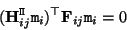
. Since the fundamental matrix maps points to corresponding epipolar lines,
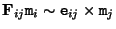 and equation (3.27) is equivalent to
![${\tt m}_j^\top [{\tt e}_{ij}]_\times {\bf H}^{\tt\Pi}_{ij} {\tt m}_i=0$](img422.gif) . Comparing this equation with
. Comparing this equation with
 , and using that these equations must hold for all image points and lying on corresponding epipolar lines, it follows that:
Let  be a line in image and let be the plane obtained by back-projecting into space. If
 is the image of a point of this plane projected in image , then the corresponding point in image must be located on the corresponding epipolar line (i.e.
 ). Since this point is also located on the line it can be uniquely determined as the intersection of both (if these lines are not coinciding):
 . Therefore, the homography
 is given by
![$[{\tt l}_j]_\times {\bf F}_{ij}$](img428.gif) . Note that, since the image of the plane is a line in image , this homography is not of full rank. An obvious choice to avoid coincidence of with the epipolar lines, is
. Note that, since the image of the plane is a line in image , this homography is not of full rank. An obvious choice to avoid coincidence of with the epipolar lines, is
 since this line does certainly not contain the epipole (i.e.
 ). Consequently,
![\begin{displaymath}[{\tt e}_{ij}]_\times {\bf F}_{ij}
\end{displaymath}](img431.gif) |
(C29) |
 and the arbitrary relative scale between
  and
and  ). Therefore, this equation can only be used to instantiate a new frame (i.e. an arbitrary projective representation of the scene) and not to obtain the projection matrices for all the views of a sequence (i.e. compute
 ). How this can be done is explained in Section 5.2.
![\begin{displaymath}
{\bf F}_{ij} \sim [{\tt e}_{ij}]_\times {\bf H}_{ij}^{\tt\Pi} \enspace .
\end{displaymath}](img424.gif)
![\begin{displaymath}
\begin{array}{rcl}
{\bf P}_1 & = & [ {\bf I}_{3 \times 3} \,...
...\tt e}_{12} {\tt\pi}^\top \, \vert \,{\tt e}_{12} ]
\end{array}\end{displaymath}](img432.gif)